
March 2026
3
03
March 2026
Event Summary | High-Level Forum on Official Statistics: "Beyond GDP: Rethinking Progress in a Changing World"

At the 2026 High-Level Forum on Official Statistics, intergenerational equity took center stage through the "Youth Moving Beyond GDP" initiative.
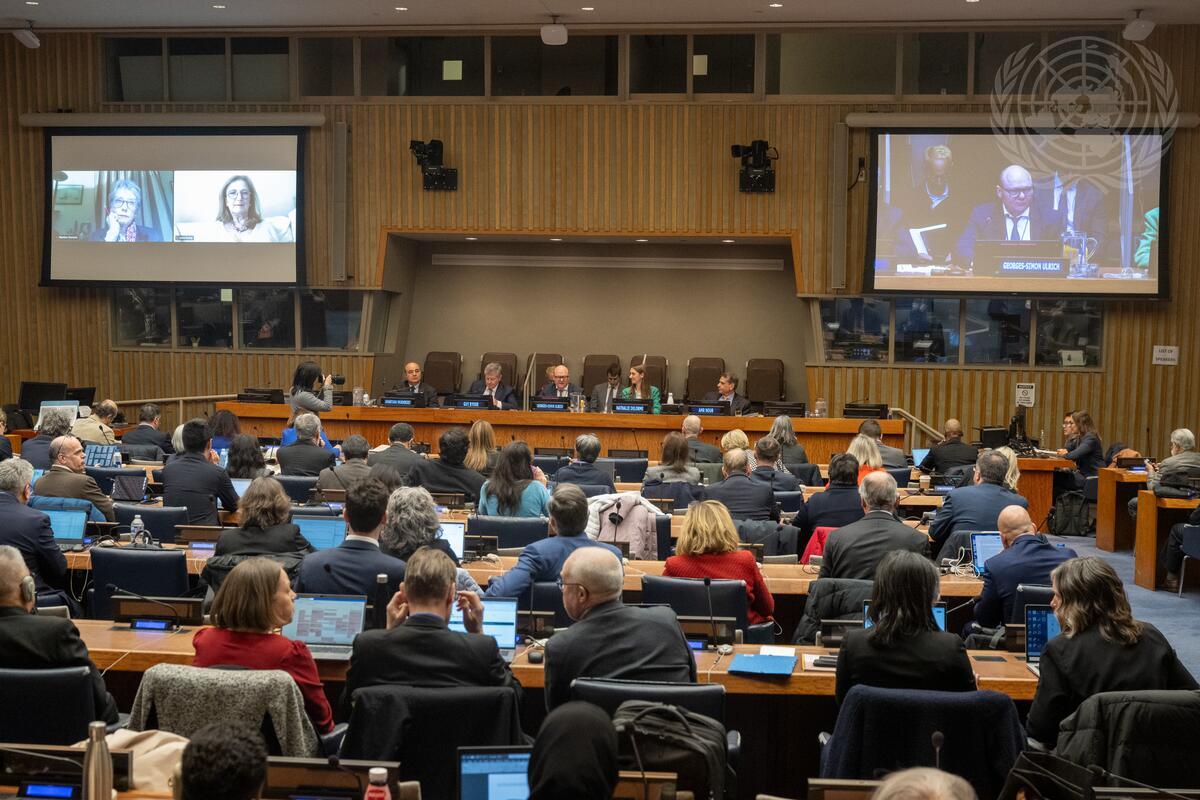
At the 2026 High-level Forum on Official Statistics, held alongside the 57th session of the United Nations Statistical Commission, the global statistical community gathered at a pivotal moment. With the Secretary-General’s independent High-Level Expert Group on Beyond GDP preparing its recommendations, the Forum became a space not only to refine indicators but also to reflect on who defines progress and for whom.
From the outset, the Youth Moving Beyond GDP initiative, a partnership between the Beyond Lab, Rethinking Economics International, and UN Trade and Development, was recognized as a shaping force in the process. Opening the Forum, Georges-Simon Ulrich, Chair of the Statistical Commission, stated: “The Youth Moving Beyond GDP initiative has been instrumental in bringing an intergenerational perspective to the Beyond GDP process, helping to shape and inspire new approaches to measuring progress on sustainable development.”
Speaking on behalf of the Deputy Secretary-General, Under-Secretary-General for Policy Guy Ryder framed the urgency of reform. GDP, he noted, has long served as a proxy for progress, but its limitations are increasingly evident: “For too long, we have measured progress by GDP alone. It has helped us measure economic activity, but it cannot tell us whether people are thriving, whether opportunity is broadly shared, or whether today’s gains are being built on borrowed time, borrowed from future generations and from the planet itself.” By linking measurement to “borrowed time,” he placed intergenerational responsibility at the heart of the discussion. He concluded with a call that mirrored the Youth Moving Beyond GDP initiative’s approach: “So let us approach this next phase as a partnership between those who produce statistics and those who use them.”

In the keynote address, Nathalie Delorme from the Beyond Lab presented the Youth Moving Beyond GDP initiative and its Youth Network as a structured platform bringing together over 1,000 young economists, statisticians, and community leaders from more than 90 countries. The keynote emphasized that if the world is redesigning how development is measured, young people must be co-architects, not observers. The Youth Network’s guiding principles, human rights-based measurement, intergenerational justice, and country-owned yet globally relevant solutions, were presented as foundational design criteria.
What followed in Session 1, “The Global Push Beyond GDP – Frameworks and Principles,” demonstrated how deeply those principles have resonated. Nora Lustig, Co-Chair of the High-Level Expert Group on beyond GDP, expanded the Group’s mandate to develop recommendations for a limited number of country-owned and universally applicable indicators of sustainable development that complement and go beyond GDP to include the objective of reflecting the multidimensional and intergenerational dimensions of wellbeing. She expressed satisfaction at the convergence emerging across stakeholders, noting: “I am really happy to hear the predecessors speak, both the USG and Nathalie […] because we are converging on the same language. That’s already a very successful process, because the visions are widely shared among those who are pursuing this agenda of Beyond GDP.” The alignment between youth contributions and expert deliberations was not incidental. It was visible and explicitly acknowledged.
During the presentation of their conceptual framework, Expert Group Member Martine Durand made that connection even more explicit: “You will recognize in the features of our conceptual framework many of the points raised by Nathalie and the Youth Network.” She explained that the Expert Group’s overall objective is equitable, inclusive, and sustainable wellbeing, grounded in foundational principles of human rights, peace and security, and planetary boundaries.
Echoing one of the key themes of spillover accountability in the Youth Network’s policy recommendations, Martine Durand stressed that wellbeing must be understood relationally and globally: “We are not concentrating on individual wellbeing […] we rather consider that the individual is intrinsically interlinked with the planet, but also in society and community. And whatever happens in one community, society, or one country has implications globally for other countries.” The Youth Network’s recommendations were presented at a joint side event with the Expert Group at the World Social Summit, alongside the Expert Group’s interim report which did not yet include spillover effects.
Most importantly, the Expert Group reinforced the intergenerational lens that youth advocates have consistently championed: “We consider today’s wellbeing not in isolation, because you could achieve wellbeing today, but it could be at the expense of tomorrow’s wellbeing. So future generations have to be taken into account. We are concerned about wellbeing both for today and for the future.” This articulation closely mirrors the Youth Network’s call to embed intergenerational justice directly into statistical design.
The discussion of spillovers, one of the Youth Network’s five core thematic contributions, also featured prominently in the preview of the Expert Group’s dashboard of indicators. Martine Durand acknowledged the complexity but insisted on its necessity: “Although it’s very challenging to develop indicators for cross-country spillovers and the global aspects of wellbeing, you can’t achieve wellbeing in one country at the expense of other countries’ wellbeing.”
Nora Lustig similarly framed Beyond GDP as: “beyond income, beyond averages, beyond today, and beyond national boundaries,” recognizing that: “Beyond boundaries represents one of the biggest challenges, given that there is no convention yet on how to measure spillovers […] But we believe this is an area that needs pursuing.”
Participation itself emerged as a structural requirement for success. Martine Durand emphasized: “It is very important that citizens, civil society, and NGOs are part of the agenda and participate in the whole Beyond GDP process.” Without this, she warned, reform risks stagnation: “Because statistical capacity without political commitment produces unused data, and political commitment without statistical capacity produces empty rhetoric.”
She added that dashboards must be embedded in real decision-making processes: “If these indicators are not integrated into policymaking and communication strategies, as well as consultation processes with civil society, then this agenda is not picked up.” The Youth Moving Beyond GDP initiative stands as an example of how to operationalize such engagement in practice.
The closing session, moderated by Samuel Kobina Annim, Director of the Africa Centre for Statistics at the UN Economic Commission for Africa, brought the day’s themes together. Reflecting on the proceedings, he placed expectations, especially from the youth perspective, at the center of his closing remarks. Looking ahead, he stressed the need for shared responsibility: “The first issue is related to collective ownership, not only within the statistical community, but […] the voices of the voiceless should also be heard.”

The Forum made clear that the Beyond GDP movement is evolving from a technical exercise into a broader transformation of governance. Youth Moving Beyond GDP and its Youth Network have not merely participated in this conversation. They have helped shape its language, priorities, and conceptual foundations. From human rights and planetary boundaries to intergenerational justice and spillover accountability, the imprint of intergenerational engagement is visible across the emerging framework and indicator dashboard.
As the process moves into its intergovernmental phase, the question is no longer whether young people belong in the Beyond GDP debate. The evidence presented at this Forum shows that their perspectives are already embedded within it. The task ahead is to ensure that this structured, meaningful intergenerational partnership becomes a permanent feature of how progress is defined, measured, and acted upon so that when we redefine progress, we truly do so for both present and future generations.
We take this opportunity to again express our deep appreciation for the engagement, expertise, and contributions of the Youth Network. This is intergenerationally equitable policymaking in practice, a bridge between grassroots action and expertise and high-level decision making. You have demonstrated that structured, evidence-based youth engagement is not only possible, but that it strengthens the process. It is also a model for participatory policymaking that can be scaled up to other processes and constituencies.
Watch the full High-level Forum on Official Statistics “Beyond GDP: Rethinking Progress in a Changing World” here (source: UN Web TV):
