
April 2026
22
22
April 2026
Event Summary | Breaking the Intergenerational Glass Ceiling: Reflections from the "Eradicating Poverty Beyond Growth: A Global Roadmap for a New Economy" Conference

At the 2026 Eradicating Poverty Beyond Growth: a Global Roadmap for a New Economy, intergenerational equity took center stage through the "Youth Moving Beyond GDP" initiative.
The Beyond Lab was proud to participate in the high-level policy conference Eradicating Poverty Beyond Growth: A Global Roadmap for a New Economy, held on 22 April 2026, organized under the mandate of the UN Special Rapporteur on extreme poverty and human rights, Olivier De Schutter, as a contribution to the International Labour Organization-led Global Coalition for Social Justice.
The event didn't just question the status quo; it unveiled a roadmap for a world where "poverty anywhere is a threat to prosperity everywhere." From the opening remarks, the tone was clear: even when economies grow, inequalities often sharpen, especially when jobs remain informal or unstable. The discussion moved beyond the "what" and "why" of economic transition into the "how".
A recurring theme throughout the summit was the failure of "green growth" to materialize at the scale required. Instead, leadership from the UN and the High-Level Expert Group on Beyond GDP (HLEG) called for a Human Rights Economy.

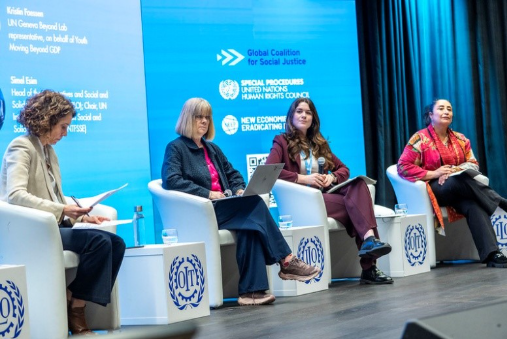
The Beyond Lab took an active role in in the conference with Kristin Faessen participating on the Panel of Session 3, where the conversation shifted toward the future of the 2030 agenda. As a voice for Youth Moving Beyond GDP, our contribution was centered on the urgent need for Intergenerational Justice. We highlighted that the "Beyond GDP" process offers a vital opportunity to narrow down the broad, sometimes overwhelming scope of the SDGs into a focused, actionable roadmap. Our contributions focused around the two main points:
At its heart, sustainable development is a simple yet profound promise: meeting the needs of the present without compromising the ability of future generations to meet theirs. However, as the discussions in Geneva made clear, the current growth-centric model is failing to keep that promise.
If we are to take this definition seriously, we must ask a critical question: Who gets to define what progress looks like today?
Young people are the primary stakeholders and the eventual "uptakers" of the economic systems being designed right now. Yet, they are frequently sidelined when the objectives are being set. We argued that excluding youth from the decision-making process is a strategic error; if the goals of today do not reflect the expertise and needs of the younger generation, those goals simply will not last.
To create a roadmap that survives the decade, we must:
A key pillar of our contribution was the need for Spillover Accountability. In a globalized economy, the perceived growth of one nation often generates "invisible" negative spillovers, such as environmental degradation or economic instability, that land heavily on another.
Currently, a nation might report high GDP growth while effectively exporting its carbon footprint or social costs to the Global South. We advocated for a new set of indicators that rigorously track these impacts. This is a matter of global intergenerational justice: ensuring that a high standard of living in one part of the world is not purchased at the expense of a young person’s future in another.
For the Beyond Lab, this conference was about more than just policy recommendations; it was about breaking the intergenerational glass ceiling.
Our Youth Moving Beyond GDP perspective is grounded in the belief that indicators must be Human Rights-Based, promote Intergenerational Justice, and be Country Owned yet Globally Relevant. Our mission is to place people and the planet as well as current and future generations, at the heart of economic systems by breaking the “intergenerational glass ceiling” in global policymaking. Therefore, we are calling for metrics complementing and going beyond GDP, that foster Resilient Well-Being, value Resilient and Fair Governance, promote Equity, Inclusion & Knowledge Justice, respect Planetary Boundaries & Environmental Justice, and track Spillover Accountability as the primary domains to measure a nation's success.
Relive the Panel “Creating the Momentum: Post-Growth and the 2030 Development Goals”: ILO Live - Creating the momentum: Post-growth and the 2030 development goals
