
June 2026
9
09
June 2026
Event Summary | Spillover-Innovation Learning Journey Hives

An Innovative Learning Architecture: The Spillover-Innovation Learning Journey
On June 2nd, 2026, the Beyond Lab at UN Geneva kicked off a new kind of collaboration, one that would have to reflect the nuanced, honest, and co-creative collaboration structure needed to address a topic as complex as spillovers. This collaboration would need to transform strategy into action.
Spillover effects are the positive or negative impacts that national policies have across borders, and they are a critical yet often overlooked dimension of long-term sustainable development.
For a long time, the Beyond Lab has asked:
How can the Lab leverage its UN platform and its multi-stakeholder relationships across public and private sectors to strengthen resilience today, accelerate progress on the 2030 Agenda, and pave the way for transformative systems thinking beyond 2030?
The Spillover-Innovation Learning Journey is now piloting an innovative peer-to-peer learning architecture to address these questions and to center, at its heart, the UN 2.0 principles of a more modern, collaborative, and integrated UN.
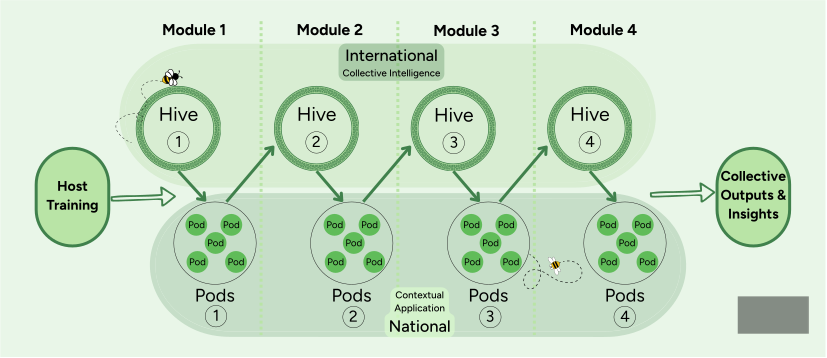
The Spillover-Innovation Learning Journey is structured around a peer-to-peer learning architecture with two prongs: the first is designed as a "Hive" and the second is designed as a "Pod."
Hive sessions are international. They center the power of collective intelligence. They aim to establish a common analytical foundation and shared language to anchor the Learning Journey.
Hives gather cross-sector representatives from all of the nations participating in the pilot, as well as hosts and invited experts, to:
Pod sessions are national. They center the power of insights that come from context-specific application. Pods serve as smaller, protected learning spaces where participants can experiment with ideas, reflect on challenges, and learn from peers within their own national context to then implement concrete actions.
Pods gather peer groups across sectors within a given nation to very tangibly:
Addressing the cross-cutting global issue of spillovers has transformative potential. Across collaborators who shared during Hive #1, the following themes emerged:
Hive #2 opened the floor to different understandings of spillovers in order to converge around a shared frame of reference and common language as a foundation for moving forward.
We were delighted to welcome guest input from Ernesto Soria Morales, Head of Programme for Policy Coherence for Sustainable Development at the OECD, sharing the OECD’s perspectives on spillovers and policy coherence, as well as input from members of our Pod from India that anchored both the conceptual and practical dimensions of spillovers. These contributions opened the dialogues of Hive #2 and Pods #2.
The OECD contributions established a conceptual framework for the group to build upon and extend with participants' perspectives. Members of our Pod from India then drove a conversation on contextual application, centering real-life examples and cases to discuss.
Different geographies face distinct spillover realities and priorities. While there was broad convergence on key conceptual elements, discussions highlighted the critical importance of contextual application. Some contexts require stronger mitigation and risk management strategies, while others focus more on narrative-building, awareness, and uptake.
This underscores that, when situating the concept of spillovers in national contexts, the types of challenges that emerge both converge and diverge, requiring approaches that are globally informed but locally adapted.
Hive #3 invited participants to step into the perspectives of other stakeholders to unpack some of the key blockers that arise when shifting from understanding spillover effects to applying them in policy and in practice. This Hive also brought into focus a key yet often overlooked stakeholder group in spillover management: the private sector.
We were very grateful to welcome rich input by members of our Pod from Türkiye, which helped illustrate how multistakeholder collaboration can serve as a pathway to navigate complexity and unlock new, harvestable opportunities for Spillover Innovation.
Even in a national context, many actors might be working on spillovers from different angles, yet they may not be connected. This situation emphasizes the value of peer-to-peer learning architecture like that of the Spillover-Innovation Learning Journey in connecting actors. The structured Hives and Pods catalyze collaborations that can extend beyond this pilot iteration.
The objective of the Spillover-Innovation Learning Journey’s innovative and systemic approaches is to embed spillover-conscious thinking into national, regional, and multilateral policy processes. Following Hive #3, participants gathered in their national contexts for Pod #3 to address the spillover management blockers relevant to them. They incorporated the multistakeholder, cross-sectoral insights from Hive #3 into their practical pathways of response to their spillover-related challenges, orienting the work session practically toward national processes and strategies.
In the final Hive of the Spillover-Innovation Learning Journey pilot, we progressed from conceptual frameworks and their positioning within national contexts towards concrete, action-oriented roadmapping for the national implementation of spillover-conscious strategies and policies. This shift from conceptual to concrete solutions is core to the programmatic offer of the Beyond Lab’s Learning Journey: assisting national offices and member states in fostering national and globally connected innovation ecosystems, as per UN2.0. In this spirit, Hive #4 opened with participants ideating key moments to tap into, to move this work forward.
We were very grateful to welcome insightful and tangible input by members of our Pod from Germany, who shared concrete best practices, lessons learned, and current and potential measures and actions for Germany to take on spillover innovation.
Germany's applied insights prompted rich discussion about the steps needed to connect and complement national and global action together. The Hive concluded with a strong plenary discussion where peer-to-peer exchange shone. Catalyzed by sector-specific examples, participants built upon one another’s ideas about what needs to form part of a Spillover Innovation implementation roadmap, bringing a true co-creative buzz to the Hives.
Thinking about how to bring Spillover Innovation home moving forward, participants shared insights about the pieces of content and process that resonated most with them throughout this pilot. Below, we share the particularly salient points that surfaced when participants reflected on their own learnings throughout the pilot and those that feel crucial to bring into implementation roadmapping.
Nearing the close of Hive #4, participants received prompts for the last of the Pods, which shift from understanding complex challenges to laying the bricks for a concrete implementation roadmap. The roadmaps developed by each respective Pod in this last session are designed to be used as national action plans, outlining next steps for moving spillover innovation forward and for continued collaboration as an innovative ecosystem.
In the UN2.0 spirit of testing and scaling novel processes and embodying a culture that values agility, learning, and curiosity, the conclusion of the pilot Hives asked participants to reflect on the structure of the learning journey. As the Beyond Lab receives feedback from participants regarding their experiences of the Spillover Innovation Learning Journey pilot at large, we look forward to sharing synthesized reflections regarding what went well and what can be improved in future iterations upon this pilot.
Across Hives, rising complexity and the need for collaborative approaches have consistently surfaced as key themes voiced by participants. Increasing geopolitical, environmental, and economic pressures are making spillovers more complex and dynamic, reinforcing the need for cross-country exchange, shared ownership, and multi-stakeholder collaboration to navigate trade-offs and identify actionable solutions.
Addressing spillovers requires a whole-of-society approach that involves governments, UN actors, the private sector, academia, and civil society. This Spillover-Innovation Learning Journey is designed as a practical space to bring actors across these spaces together, to experiment, exchange, and translate learning into action, as a support to existing work.
We extend our deep gratitude to each Pod Host for bringing together the national pods; to the Federal Ministry for Economic Cooperation and Development (BMZ) for making the Spillover-Innovation Learning Journey possible; to our partners at the UN Innovation Network (UNIN), the UN Development Coordination Office (DCO), and Huddlecraft, a peer-to-peer expert facilitator; and, of course, to Germany, India, Pakistan, and Türkiye, for being the inaugural Pods to participate in this pilot iteration.
In complement, the overarching work of the Beyond Lab is made possible by the Swiss Agency for Development and Cooperation. Thanks to the SDC, the Lab is able to offer process and content innovations that operationalize UN2.0 and work creatively and concretely toward intergenerationally equitable, regenerative development systems.
The depth of insights shared, particularly in Hive #4, made it clear that while this formal Spillover Learning Journey pilot is wrapping up, the momentum and the vital conversations we have started are only just beginning.
As an immediate next milestone, the Beyond Lab will be hosting an official side event of the High-Level Political Forum (HLPF) on July 16, 2026. This will be an exciting opportunity to bring the collective insights to a broader stage and continue driving the implementation roadmap forward.
To stay up to date on the evolution of Spillover Innovation and look out for an event summary recapping the highlights and takeaways of HLPF, follow the Beyond Lab on LinkedIn.
