
September 2026
8
08
September 2026
Six winning projects from more than 600 submissions across 90 countries and territories offer different perspectives on the future of development beyond 2030.
What should development look like beyond 2030? How can we shift from simply sustaining resources to regenerating them, leaving a fairer and more just world for future generations? In a time marked by interconnected crisis how can we sustain hope, as well as create a constructive space for what we do not yet know?
These questions were at the heart of the Beyonds Challenge, launched by the Beyond Lab at the United Nations Office at Geneva as a global, participatory and cross-disciplinary invitation to reimagine the future of development beyond 2030.
The Challenge invited participants of all ages from around the world to respond to four “Beyonds”: Regeneration, moving from sustaining to restoring and healing; Constructive Hope, moving from fear and division towards positive change; Debt to the Future, shifting from short-term fixes towards intergenerational equity; and The Great Unknowns, embracing uncertainty rather than seeking to control it.
The response was remarkable. More than 600 submissions from 90 countries and territories brought together ideas from young people, researchers, artists, policymakers, filmmakers, designers and practitioners. The submissions took many forms, including policy proposals, essays, films, poetry, participatory design and other creative works.
Following the selection process, six winning projects were chosen. They approach the future from very different perspectives, while sharing a common desire to rethink how we respond to the challenges of the present and anticipate the ones to come.
Scrolling Away from Democracy: How Social Media Fuels Political Disengagement and Why Youth Voices Hold the Key to Change
Constructive Hope
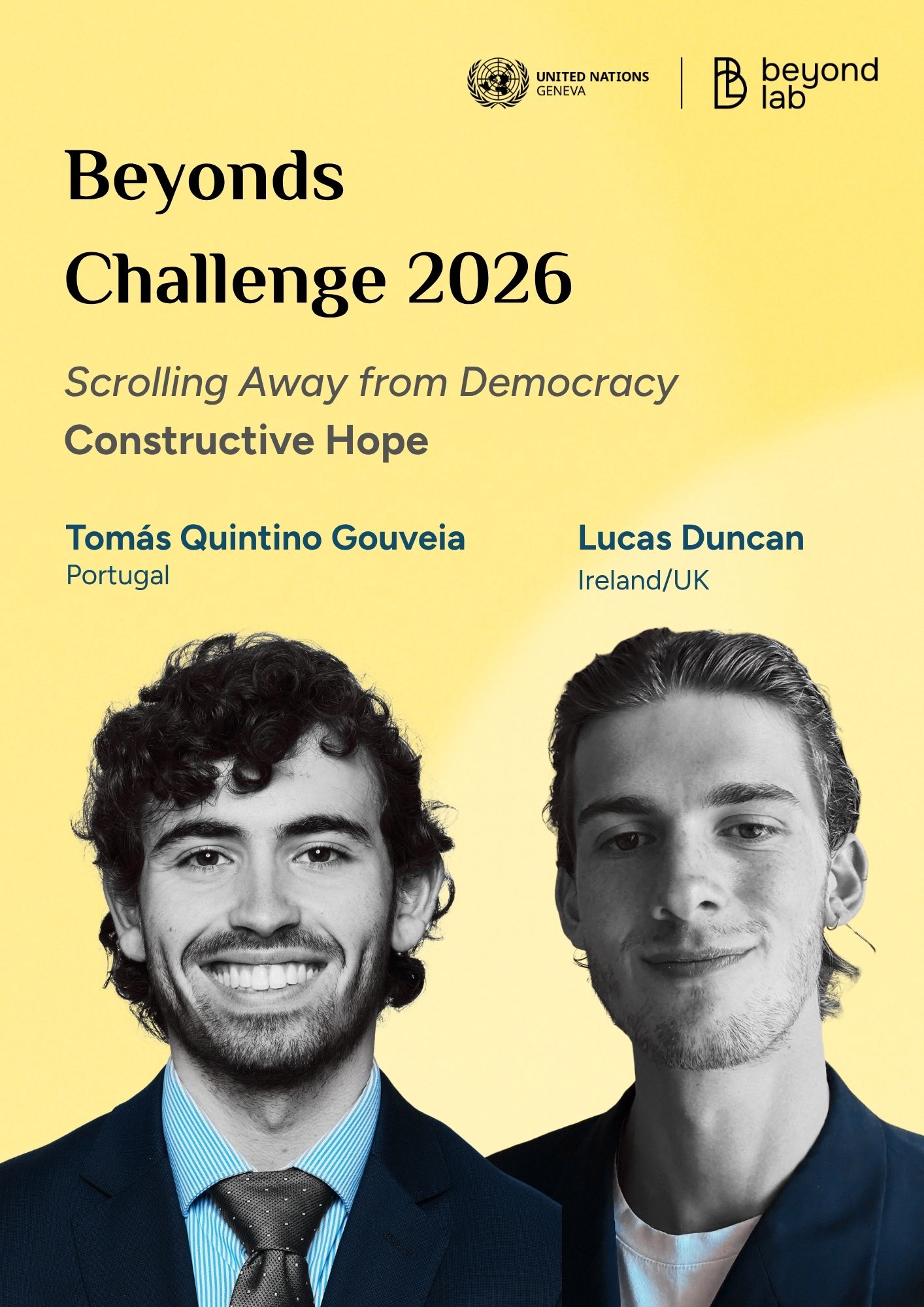
Lucas Duncan and Tomás Quintino Gouveia examine youth political disengagement in the age of social media algorithms and ask how young people themselves can play a greater role in shaping policy responses.
Their proposal applies the Hope Method’s concept of “Affective Scaffolding” to policymaking and citizen engagement. Through a PESTL analysis of algorithmic governance, they explore how participatory processes can make space for emotional expression alongside technical expertise, helping to build the empathy and mutual commitment needed for collective action.
At the heart of their proposal is a reconsideration of who gets heard and how they are heard. Young people are approached as essential knowledge-holders in policymaking, with more representative and emotionally attuned forms of engagement offering a possible way through entrenched policy deadlocks.
Their backgrounds closely connect with this work. Lucas is a researcher in political economy and science, technology and innovation policy, and currently works as a strategic foresight advisor at the Copenhagen Institute for Future Studies. Tomás is a master’s student in Digital and New Technologies Public Policy at Sciences Po Paris, with experience spanning innovation policy, European technology policy and artificial intelligence.
Dear Members of the Human Race
The Great Unknowns
Through poetry and audio storytelling, Priscillia Afolabi Adesina reflects on humanity’s capacity to heal, grow and recreate, even when the world around us appears uncertain or beyond repair.
Her work looks directly at the contradictions of the human experience: our capacity for both beauty and devastation, our relationship with the Earth, and the possibilities that remain even when the way forward is unclear.
As she writes,
even when things look beyond repair, we have an innate ability to regenerate.
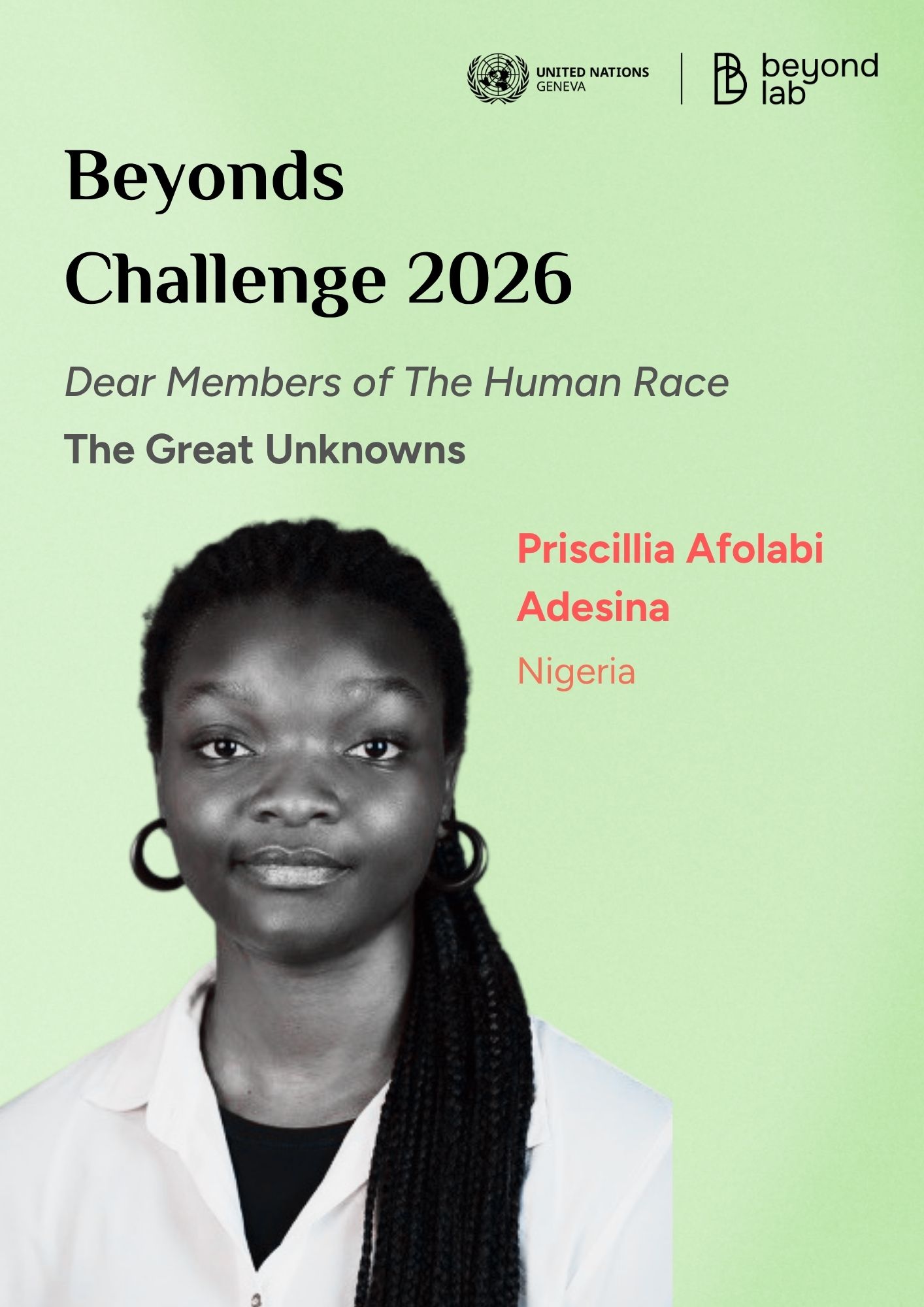
The work is ultimately a call for agency. Faced with uncertainty, Priscillia asks us not simply to imagine that another future is possible, but to recognise our own role in creating it.
Priscillia was born and raised in Nigeria and is currently completing a bachelor’s degree in International Relations. Her interest in storytelling is deeply personal. Writing first became a way for her to express herself when she found that difficult as a child. Today, she works at the intersection of storytelling, social and environmental change, and sustainable living, with a belief in expression as a tool for positive action.
The Debt to the Future: A Framework for the Post-2030 World
Debt to the Future
Maitha Mathias begins with the idea that every action, invention and policy made today affects the conditions of life available to those who are not yet born.
He describes Debt to the Future as both a moral and measurable responsibility. In his words,
humanity lives on borrowed time.
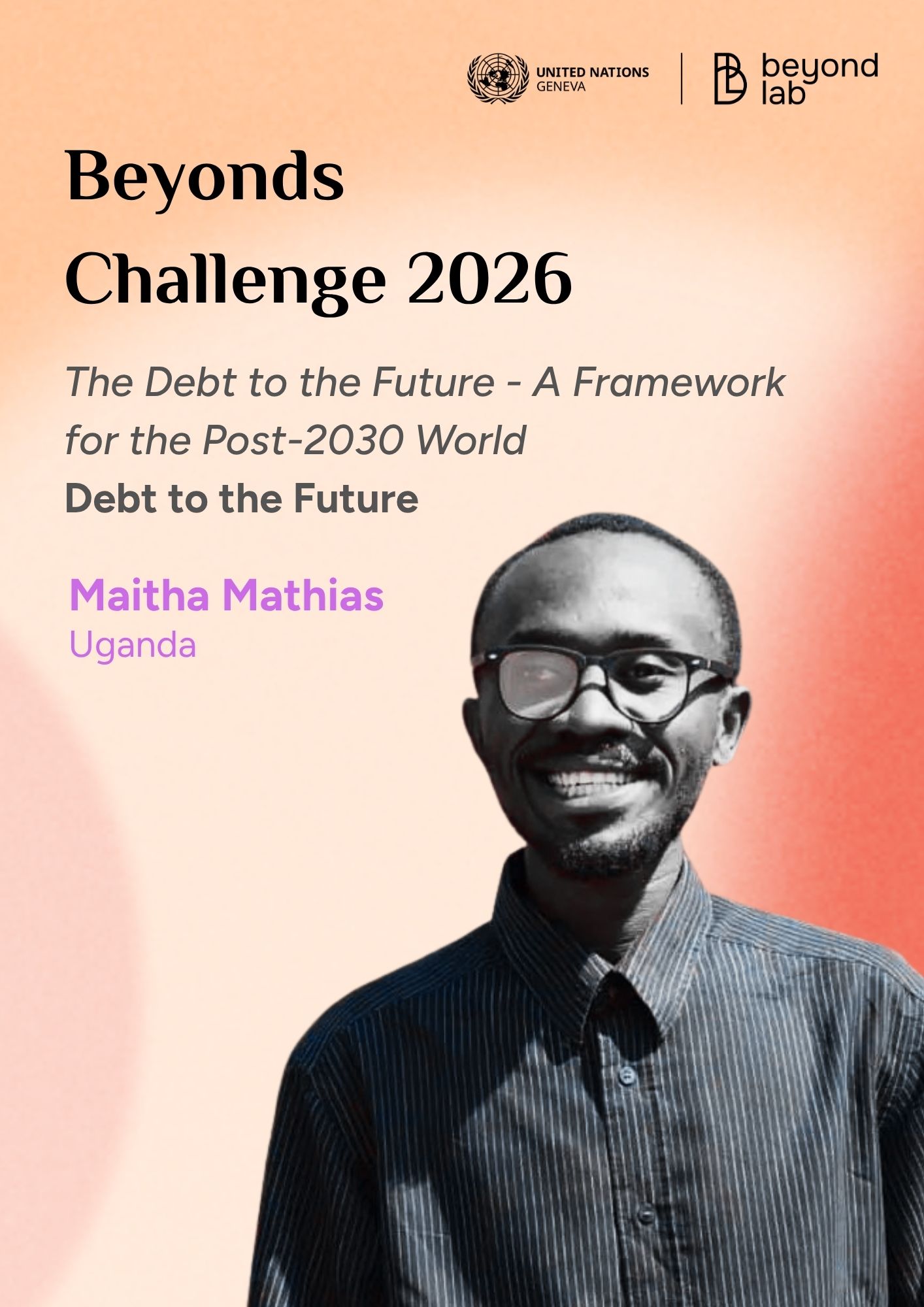
Reflecting on the Sustainable Development Goals and the limitations of short-term thinking, Maitha developed Thirteen Guiding Laws for the Future. The framework considers ecological, cognitive, material and governance responsibilities, asking what development might look like if decisions were assessed through their long-term consequences and their ability to preserve possibility for future generations.
Maitha is a researcher and educator from the Democratic Republic of Congo, based in Uganda. His work focuses on governance, climate change and sustainable development. His research considers how present decisions influence future social, institutional and environmental conditions, particularly in contexts affected by displacement, resource constraints and environmental change.
The Living Heritage Ledger
Debt to the Future
The Living Heritage Ledger brings another dimension to the idea of Debt to the Future: cultural inheritance.
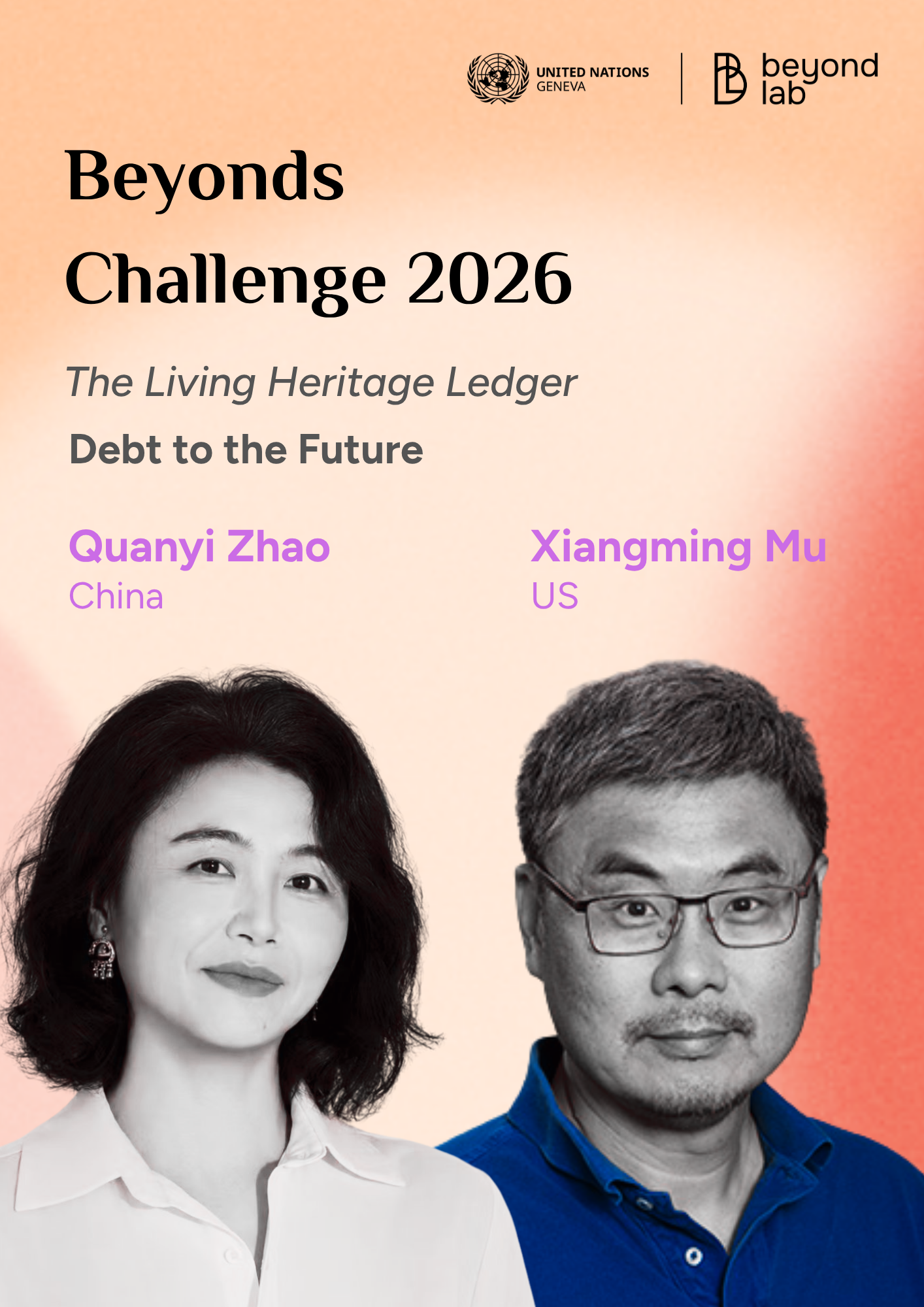
The project starts from the responsibility created when the present benefits from knowledge, culture and resources inherited from previous generations, but fails to preserve the conditions needed for future generations to inherit them.
When living heritage disappears, the loss goes beyond the practice itself. Embodied knowledge, local identity, community memory and different ways of understanding and living in the world can disappear with it.
The project proposes a method prototype designed to identify and reduce this form of cultural inheritance debt. It uses five accounts: Knowledge Continuity, Intergenerational Access, Dignified Livelihood, Community Embeddedness and Responsible Adaptability. Together, they provide a way to consider whether a living heritage practice is being sustained or whether its loss is being passed forward.
The prototype is demonstrated through Yangtze River Basin Tiaohua counted-thread traditions, bringing questions of cultural continuity into the wider discussion on intergenerational equity.
The project brings together the complementary backgrounds of its two creators. Quanyi Zhao is an Associate Professor in the School of Art and Design at Hubei University of Technology and an MFA candidate at the University of Wisconsin–Milwaukee's Peck School of the Arts, where her work connects art, design, cultural heritage and emerging technologies. Xiangming Mu is an Associate Professor in the School of Information Studies at the University of Wisconsin–Milwaukee. His research spans information retrieval, artificial intelligence and human-information interaction, with more recent work exploring AI-mediated approaches to cultural heritage learning.
The Kwentuhan Model for Regenerative Design
Regeneration
For Rosalie Lebante,
regeneration is not sustaining what exists. It’s healing what was broken.
Her project looks at what design can become when communities are recognised as holders of knowledge and active participants in shaping their own futures.
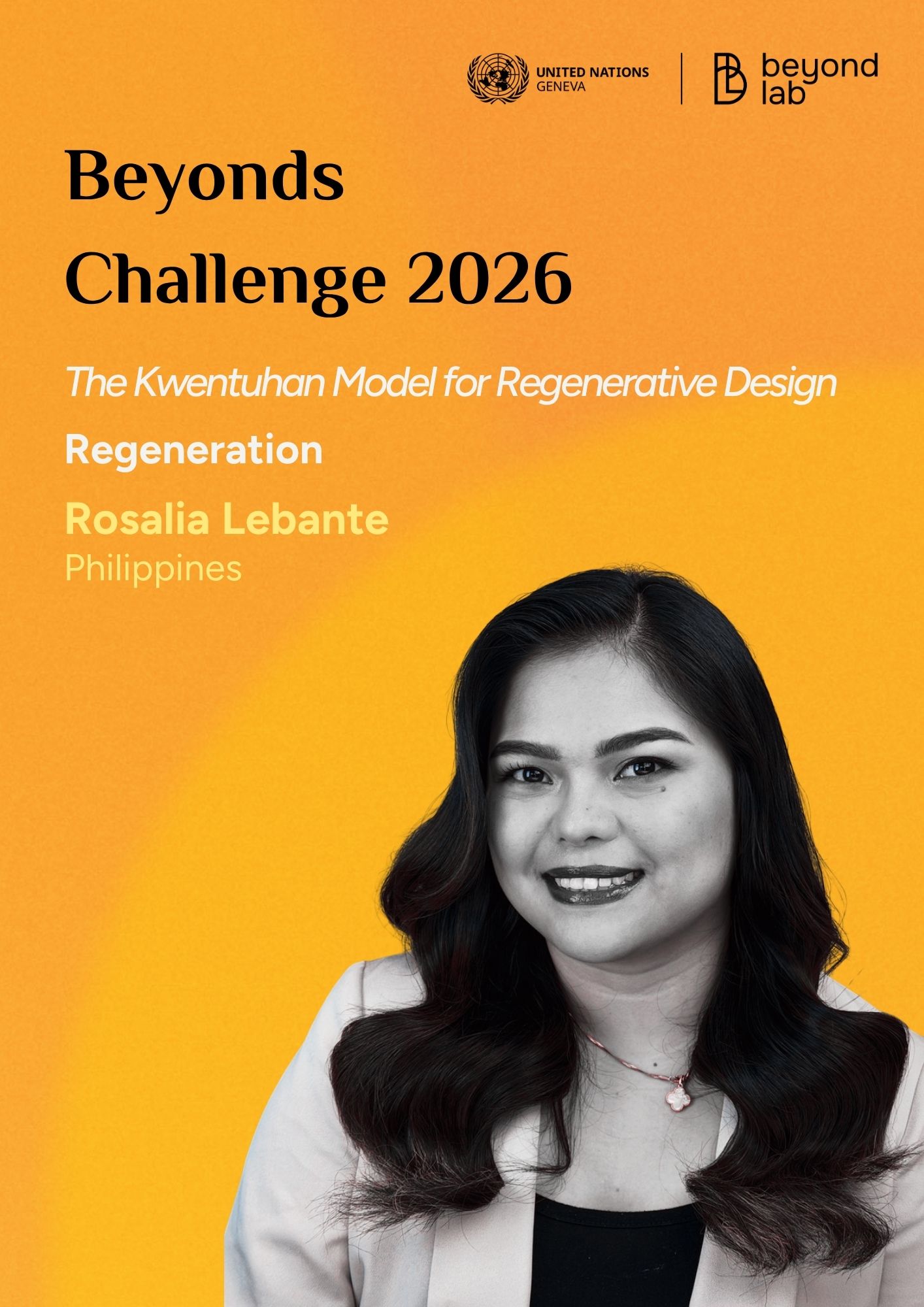
Inspired by the Filipino concept of ginhawa, or collective ease and harmony, the Kwentuhan Model is a participatory design methodology for regenerating culture, memory and collective well-being. It works through five stages: Circle Configuration, Belief Mapping, Historical Consciousness, Dialogic Exchange and Action Formation.
The methodology grew from practice. In October 2025, sixteen people gathered in a café in Puerto Princesa, Palawan, with no stage and no hierarchy. Together, they explored design beyond form and aesthetics, looking at its connections with identity, empathy, cultural continuity and social change.
The work has since led to further community conversations, partnerships and initiatives. Rosalie, with preferred name "Sally", is a graphic designer and the founder of Five300 and Creative Isla Movement in Palawan. Across her work, she explores how design can begin with a place’s own knowledge, history and identity. Her Design Kwentuhan methodology has since been practised across three sessions with 83 participants across Palawan.
Ninawa: Landmarks of Hope
Regeneration
Oliver Sullenger explores regeneration through the relationship between people, land and cultural continuity.
His short documentary, Ninawa: Landmarks of Hope, follows an Indigenous community in the Amazon fighting to reclaim its ancestral territory and have it officially recognised.
.jpg)
The film brings questions of Indigenous knowledge, environmental stewardship and ancestral land into the conversation on regeneration. Through the community’s experience, it shows how protecting land can also mean protecting culture, relationships and ways of life.
Oliver is a Swiss-American filmmaker and community builder whose work explores consciousness, human flourishing, and our relationship with nature and culture. His documentaries bring together Indigenous wisdom and environmental stewardship, using storytelling to encourage reflection, dialogue and positive change.
The six winners represent part of a much wider collection of ideas generated through the Beyonds Challenge. More than 50 additional outstanding works have also been selected to be showcased through The Beyonds Festival 2026 and its related outputs.
The winners will come together in Geneva for The Beyonds Festival 2026, from 5 to 7 October at the Palais des Nations, where they will share their work and join conversations with experts and participants from across generations, sectors and regions. The Festival is also an official satellite event of the United Nations Youth Office’s Youth Townhall, connecting ideas emerging from the Challenge with wider conversations on the future beyond 2030.
Click to register your seat, and...stay tuned!
