
April 2026
22
22
April 2026
Event Summary | Valuing What Counts: Bridging the Gap Between Metrics and System Change at the UNECE Regional Forum

At the 2026 UNECE Regional Forum on Sustainable Development, the Beyond Lab led a critical dialogue on moving "Beyond GDP" from a conceptual framework to a practical driver of policy and investment.
The Beyond Lab was proud to participate in the UNECE Regional Forum on Sustainable Development, a key milestone in aligning regional action with the global push for a more holistic economic compass. As the world navigates a series of interconnected crises of climate instability and rising inequality, the limitations of our current primary metric, Gross Domestic Product (GDP), have become increasingly consequential.
The Forum provided a platform to reinforce a growing global concern: GDP is an incomplete indicator to measure a country’s progress. It captures the value of production but fails to account for how that value is distributed, whether it enhances well-being, or the environmental cost of "growth". The discussion underscored that economic success can no longer be decoupled from social inclusion and planetary health.

The UNECE region is uniquely positioned to lead this transition. By combining high-income economies with countries in transition, it offers a varied landscape to test and scale metrics that reflect well-being, sustainability, and equity.
However, as the session made clear, the link between data and policy remains weak. To move forward, we must build institutional capacity and ensure that the "Common Agenda" for valuing what counts is not just a UN mandate, but a lived reality for policymakers across the region.
The Beyond Lab took a central role in the forum, with our Director Özge Aydogan moderating the pivotal session, "From Metrics to Policy and System Change". This segment moved past the theoretical "why" of the Beyond GDP debate to focus on the technical and political "how."
The discussion centered on transforming the "Beyond GDP" framework from a statistical exercise into a tool for real-world decision-making. Our contributions and the panel's findings focused on three core pillars:

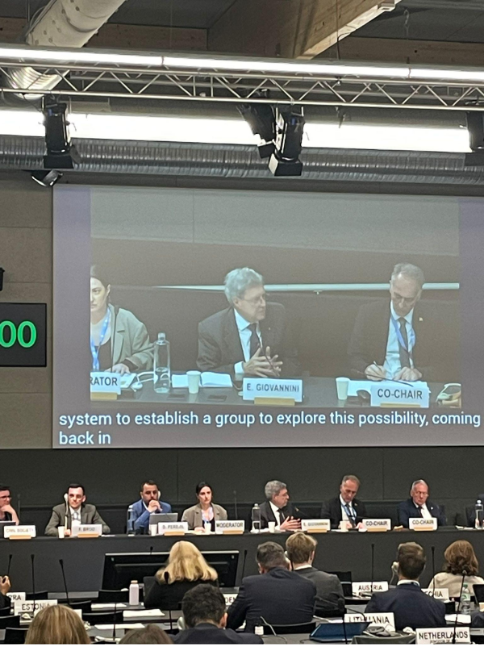
The session opened with a powerful call to action from Enrico Giovannini, member of the High-Level Expert Group (HLEG) on Beyond GDP. His intervention provided the technical and strategic foundation for the discussion, emphasizing that the evolution of our metrics is not about discarding the past, but building a more comprehensive future.
Giovannini argued that the key breakthrough will come from asking the statistical community to explore a System of Wellbeing Accounting (SWA). Crucially, this is not a proposal to replace the existing System of National Accounts (SNA), which remains a vital tool for monitoring market activity. Instead, the SWA would:
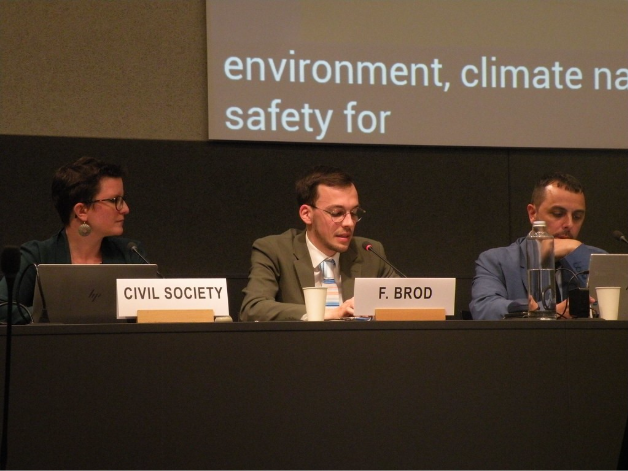
A highlight of the session was the contribution from Florian Brod, representing the Beyond Lab Youth Network on Beyond GDP, who presented a youth perspective of principles and requirements for a Beyond GDP world. His intervention highlighted a profound shift in the cultural and economic narrative between generations.
Florian reflected on the traditional narrative of previous generations, the parental hope that their children would "have it better," usually defined by financial gain and material wealth. However, for the current generation, the definition of "better" has fundamentally changed. It is no longer just about financial stability, but about environmental justice and the right to inhabit a livable planet.
To turn this narrative shift into policy, Florian outlined a framework of requirements for the next generation of metrics:
For the Beyond Lab, this session was a call to action to move Beyond GDP from concept to practice. We believe that for a new economic roadmap to be successful, it must be based on these guiding principles:
The UNECE Regional Forum on Sustainable Development was more than a technical meeting; it was a demonstration of a shifting tide. By integrating Enrico Giovannini’s vision of a System of Wellbeing Accounting with the youth-led demand for a new narrative of "better," the Beyond Lab is helping to bridge the gap between metrics, lived realities, and system change.
Our mission remains clear: to break the “intergenerational glass ceiling” in global policymaking. We are calling for metrics that foster Resilient Well-Being, value Participatory & Fair Governance, promote Equity, inclusion & Knowledge Justice, respect Planetary Boundaries & Environmental Justice, and track Spillover Accountability.
As we move toward the next chapter of the 2030 Agenda, the Beyond Lab continues to advocate for a world where progress is measured not just by the wealth we create, but by the well-being we foster for generations to come.
Relive the plenary session: Plenary Session and Closing - Regional Forum 2026 | UN Web TV
