
June 2026
3
03
June 2026
Event Summary | Youth Network Town Hall with the High-Level Expert Group on Beyond GDP

Youth Network Town Hall: An Exchange with the High-Level Expert Group
Following the highly anticipated publication of the Final Report of the United Nations Secretary-General's independent High-Level Expert Group on Beyond GDP, the Beyond Lab, alongside its partners from UN Trade and Development (UNCTAD) and Rethinking Economics International, hosted the Youth Network Town Hall on Beyond GDP on June 3, 2026.
This special session, held at the initiative of the Expert Group, served as a profound celebration of the Youth Moving Beyond GDP initiative and featured an exclusive presentation and interactive dialogue with High-Level Expert Group member Prof. Enrico Giovannini, as well as a unique engagement with the Governmental of Spain, co-leading the recently launched Beyond GDP negotiations among Member States at the UN.
The event marked a major milestone by bringing together global expertise, intergenerational leadership, and national implementation efforts. The Youth Network Townhall underscored a definitive shift in how international policy can, and should, be shaped: through inclusive and intergenerational engagement.
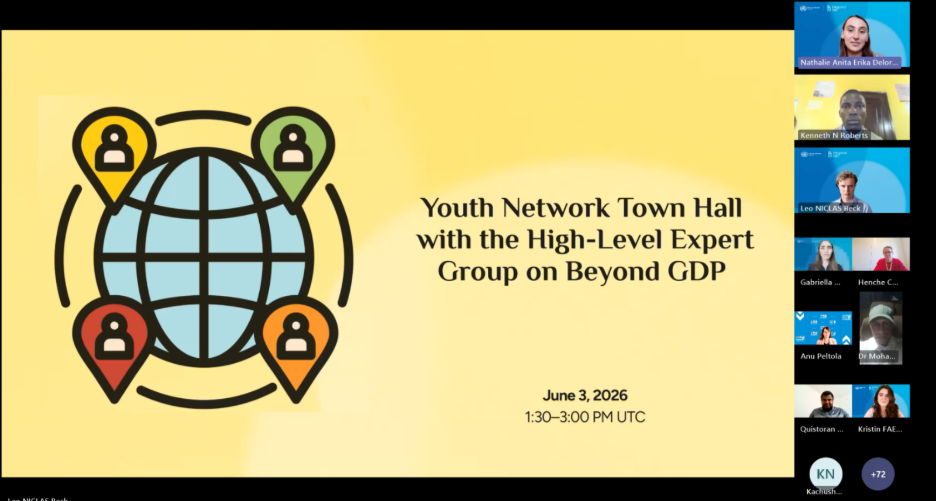
The session opened with a celebration of the true driving force behind this process: the Youth Network on Beyond GDP and its ability to challenge conventional thinking constructively while calling for high ambition and inclusion of different voices.
The opening remarks by Ms. Anu Peltola, Director of Statistics, Data and Digital Services at UN Trade and Development (UNCTAD), set a celebratory tone and explicitly recognized the immense commitment, leadership, and contribution of the Youth Moving Beyond GDP initiative to the borader global process.
The Youth Network has proved to serve, and in turn be recognized, as a genuine consultative partner to the Expert Group. The launch of the final report is therefore not just an institutional milestone, but also a concrete testament to the Youth Network’s success in moving intergenerational perspectives from the margins of global economics straight into the center of 21st-century policymaking.
The opening segment was followed by a special presentation and conversation with Prof. Enrico Giovannini, a member of the High-Level Expert Group. Prof. Giovannini presented their report’s key findings, which include a set of 31 complementary indicators grounded in three foundational principles: peace, human rights, and respect for the planet. These indicators represent a vital step toward measurement systems that are truly aligned with today’s and tomorrow’s realities, complexities, and systemic challenges, while better reflecting what matters most to both people and the planet.
The highlight of the Town Hall was the conversation that moved the meeting from a traditional, one-way presentation into a vibrant and highly interactive exchange. Members of the Youth Network took the floor to pose questions, challenge traditional economic assumptions, and broaden the perspective of the dialogue.
By addressing issues from national implementation to private sector engagement, Youth Network members continued to demonstrate their ability to engage as substantive contributors to the conversation. This bridge between high-level institutional expertise and grassroots ambition demonstrated the immense value of real intergenerational participation in global policymaking.
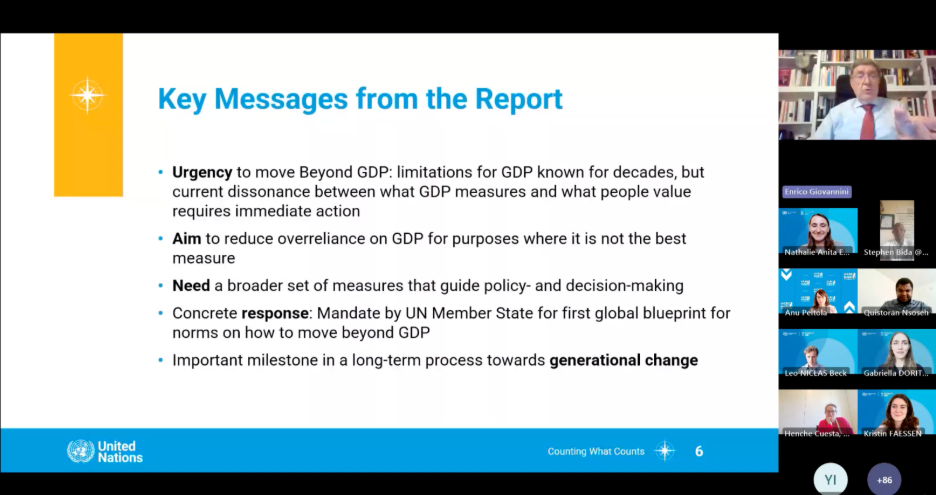
What truly distinguishes the Youth Moving Beyond GDP initiative is not only what has been proposed in the final report, but how the entire process unfolded. From the outset, the work was shaped through a deliberately inclusive, participatory, and evidence-based approach.
Following the initial launch of the interim report at the World Social Summit, together with the Youth Network's policy recommendations, the Expert Group opened its consultations widely, systematically gathering inputs from diverse stakeholders across various regions and sectors.
A particularly pathbreaking dimension of this process has been the meaningful integration of intergenerational perspectives through the Youth Network. Detailed in the full comparative analysis, the inclusion of the Youth Network’s Policy Recommendations into the final report ranges from an intergenerational scope to spillover accountability.
Working in close alignment with the Expert Group's process, the Youth Network substantively contributed to a major global policy discussion by:
The contributions of the Youth Network have directly helped shape a major global policy discussion, proving that intergenerational equity can substantively alter and improve the trajectory of global economic frameworks.
With the global blueprint established, the Town Hall emphasized that attention must turn to implementation. The conversation is now shifting from why we need to move beyond GDP to how countries can do so in practice. As the focus transitions toward implementation, national-level action and grassroots engagement will be absolutely essential.
As countries begin translating these global recommendations into concrete national practices, intergenerational engagement will once again be key. Young people are uniquely positioned to help ensure that national priorities reflect long-term thinking, diverse lived experiences, and the distinct perspectives of current and future generations.
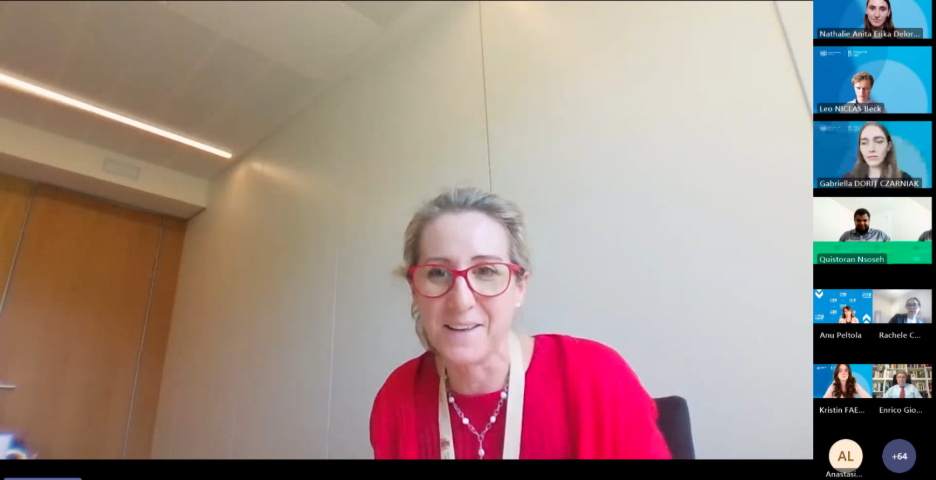
The Youth Network Town Hall concluded with closing remarks by Ms. Ana Henche Cuesta, Head of Development Financing in Spain’s General Directorate of Sustainable Development Policies. As co-facilitator of the intergovernmental process on Beyond GDP, Spain’s engagement at the Town Hall highlighted the Youth Network’s relevance in helping governments implement the Beyond GDP framework.
The discussion highlighted the need for a highly participatory process, a conversation that the Youth Network has already been actively leading. The closing contribution emphasized that the agenda's success depends on combining internationally comparable approaches with the flexibility to adapt to national contexts. Because of this, the movement must reach beyond technical communities and into the public eye via universities, media, and broader society.
Ultimately, the Beyond GDP process offers both a substantive and a procedural blueprint. It proves on a global stage that inclusive, transparent, and participatory approaches lead to inherently stronger, more resilient, and more legitimate policy outcomes.
We extend our sincere gratitude to all the partners who made this Town Hall a success. A special thank you goes to our esteemed speakers, Ms. Anu Peltola, Prof. Enrico Giovannini, and Ms. Ana Cuesta Henche, and above all, to the Youth Network for their active participation and continued engagement.
The Town Hall was a vital opportunity to celebrate these collective achievements, while serving as a collaborative space to think about the next chapter. As the session concluded, the Youth Network left with a shared commitment to addressing the defining questions of the road ahead:
