
July 2026
7
07
July 2026
Event Summary | Stakeholder Consultation for the Intergovernmental Process on Beyond GDP

Opening the Floor for Stakeholder Consultations on Beyond GDP: Interventions by the Youth Network
On the heels of the transition between the technical phase of the UN’s Beyond GDP process, under the mandate of the Secretary-General's independent High-Level Expert Group, and the political phase, led by Member States, the intergovernmental process on Beyond GDP held its first consultation with stakeholders on 7 July 2026.
The "Youth Moving Beyond GDP” initiative was honored to be approached by the UN's interagency Beyond GDP Secretariat, on behalf of the Co-Facilitator of the intergovernmental process, Spain, to set the stage at the beginning of the open floor of this virtual consultation, leveraging its knowledge of the Beyond GDP agenda and its intergenerational approach.
Two speakers from the initiative’s Youth Network on Beyond GDP, launched in partnership with UN Trade and Development (UNCTAD) and Rethinking Economics International, contributed to the consultation.
The virtual consultation convened more than 200 representatives across sectors of society in a virtual stakeholder consultation to hear diverse perspectives on scope, conduct, and expected outcomes for the process.
The intergovernmental process was mandated by Member States through the Pact for the Future, and Spain was appointed as co-facilitators in April 2026. Through this process, Member States will consider agree on necessary actions to consider how to complement GDP with broader measures of progress that better capture people’s well-being, inclusion, and sustainability. The actions to be deliberated include the recommendations in the final report of the High-Level Expert Group on Beyond GDP, substantively shaped by the Youth Network on Beyond GDP, as well as additional inputs contributed by stakeholders.
Over the past year, the Youth Network has been engaged at almost every stage of the Beyond GDP process, from co-creating policy recommendations to contributing to discussions at the Financing for Development Conference (FfD4), the first Expert Group consultation at UN High-Level Political Forum (HLPF), UNCTAD16, and the World Social Summit (where the High-Level Expert Group's interim report was co-launched alongside the Youth Network recommendations), or the High-Level Forum on Official Statistics. The High-Level Expert Group’s integration of so many of the Youth Network recommendations on moving beyond GDP into their final report, released in May 2026, was a momentous marker of the impact that the Youth Network has delivered in under a year (full analysis here).
The Permanent Mission of Spain to the UN, in its capacity as Co-Facilitator of the intergovernmental process on Beyond GDP, opened the consultation by emphasizing their commitment to an inclusive intergovernmental process. They emphasized convergence around not just including, but also institutionalizing and resourcing participation modalities for youth, as well as a need to engage local governments, civil society, business, and investors in the process and communicate progress clearly so that it can be used by the people and its impacts can be felt in people’s daily lives.
Twenty-five oral interventions were made. In this summary, we focus on those made by the Youth Network, but a full summary report can be found at the UN Beyond GDP website, provided by the UN Secretariat.
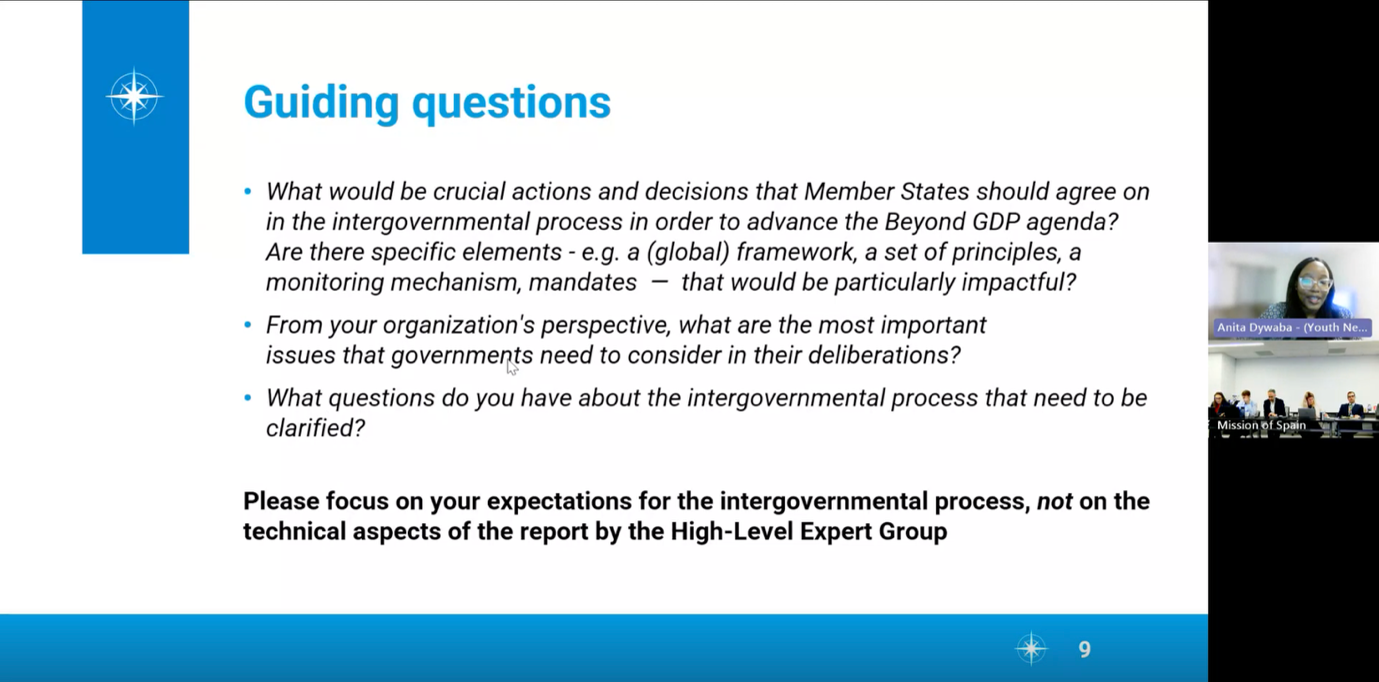
Our first Youth Network speaker to make an intervention was Ms. Anita Dywaba, a South African policy specialist and candidate researcher with the Institute for Social and Economic Policy. Ms. Dywaba opened her intervention by highlighting the Youth Network on Beyond GDP, which has grown into a community of more than 1,000 young people from over 90 countries, with approximately 80% from the Global South.
In terms of recommendations, Ms. Dywaba called upon governments to carry forward the Youth Network recommendations formalized by the Expert Group in the final report, including: recognizing human rights and respect for the planet as foundational principles of well-being and economic progress; embedding intergenerational equity; and accounting for transboundary spillover effects of national decision-making.
Finally, and crucially, she urged governments to examine the political economy of youth inclusion itself and recognize, resource, and institutionalize co-creating with young people as experts in their own lived and local experiences. She closed by underlining that the shift beyond GDP must be shaped by those with the greatest stake in its future: young people and communities across the Global South.
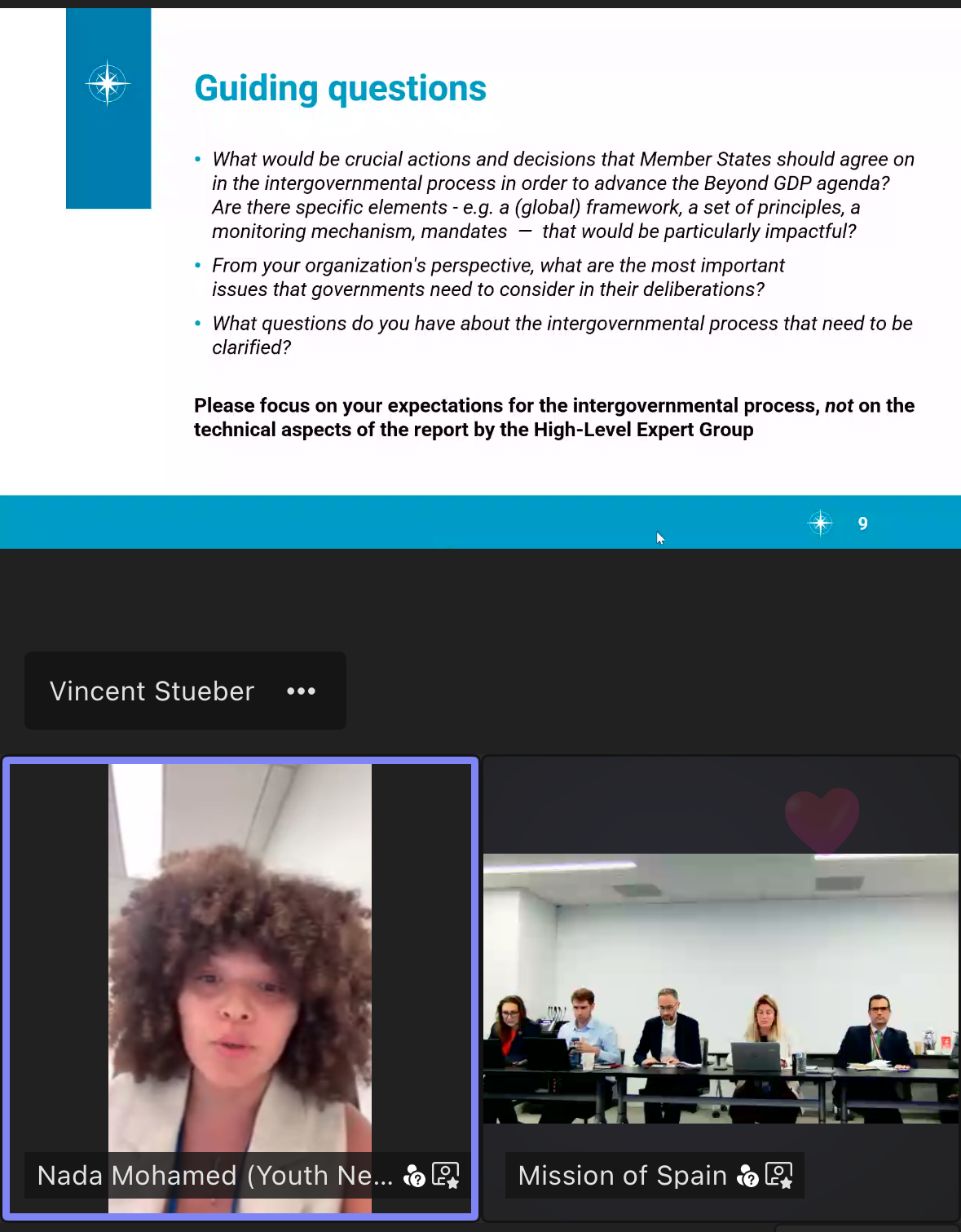
Our second Youth Network speaker to make an intervention was Ms. Nada Mohamed, an Egyptian climate justice activist. Ms. Mohamed spoke about the importance of defining a well-being economy through lived experience and local science, emphasizing that the intergovernmental process has the opportunity to not just count what counts, as centered in the final report by the Expert Group, but further to count who counts, to ensure a truly just economic system.
Ms. Mohamed called upon Member States to leverage the Youth Network to shape and refine the design, monitoring, and evaluation of viable solutions to moving beyond GDP.
Lastly, she urged that transforming our global economic system into one that more holistically considers well-being requires much more than data collection; she urged the intergovernmental process to leverage human rights education and the agency of local communities to define wellbeing and the beyond GDP indicators.
To close the virtual consultation session, the Co-Facilitator announced the upcoming elements paper and a call for written contributions, to which the Youth Moving Beyond GDP initiative will be submitting a consolidated input based on contributions by Youth Network members.
To read the full summary of the stakeholder consultations for the intergovernmental process on Beyond GDP, follow related events, and learn more about the technical phase that led up to it, visit the UN Beyond GDP website.
